

Which measures should large organizations use to incentivize whole workforce change?
In today's rapidly evolving landscape, both businesses and government departments face a myriad of challenges that demand flexibility, innovation, and responsiveness. There are many driving forces behind these changes, including emerging technologies within industries, external disruptions, shifts in customer demographics, and changes in both customer and workforce preferences. Additionally, government organizations may be compelled to change due to new policy directions and citizens.
These significant transformations often necessitate organizational-wide adjustments, including redefining operating models, adopting new work methodologies, and realigning corporate culture. In this article, we will delve into the crucial aspect of incentivizing the workforce during times of change and explore various measures that large organizations can employ to effectively drive culture change.
WHY CONSIDER INCENTIVIZING THE WORKFORCE DURING TIMES OF CHANGE?
Incentives play a pivotal role in driving change within businesses and government entities by accomplishing the following:
- Fostering Engagement and Motivation: Change requires effort, and if organizations want their employees to embrace new behaviors and implement different practices, there must be a personal reason for them to do so. Incentives create a sense of purpose and motivation among individual employees, ensuring continuity in operations and retaining the essential skills needed for future success. By aligning incentives with the goals of change initiatives, organizations can engage employees and inspire them to actively contribute to the transformation process.
- Aligning Individuals and Teams: Incentives help align individuals and teams with the desired outcomes and objectives of the organization. By directly linking incentives to key performance indicators and Objectives, organizations can effectively channel collective efforts towards achieving desired outcomes in the present and the future.
- Reinforcing Desired Behaviors: Incentives play a vital role in reinforcing behaviors and attitudes necessary for successful change within government organizations. By recognising and rewarding behaviors that support the change objectives, organizations can foster a culture that embraces and sustains the desired change.
Remember, incentives are not just about rewards; they are the catalysts that unlock potential, drive innovation, and ultimately lead your organization to ambitious achievements.
SETTING THE SCENE FOR CHANGE
To facilitate successful change within organizations, specific considerations and strategies are necessary:
- Communicate the Burning Platform and the Future Vision: Clear and effective communication is essential in conveying the need for change to employees. This includes articulating the rationale, goals, and expected outcomes of the change initiatives. By effectively communicating the importance and benefits of the change, organizations can generate employee buy-in and support.
- Gain Leadership and Stakeholder Engagement: Establishing clear lines of communication, decision-making, and accountability is crucial. Leaders should actively participate in the change process by providing guidance, support, and addressing employee concerns. Engaging stakeholders helps ensure a comprehensive understanding of the change and facilitates effective decision-making.
- Provide Transparent Communication and Expectation Management: To minimise resistance, leaders should clearly communicate the scope, timeline and impact of the change initiatives and workforce planning impacts. Continual updates on progress, milestones and potential challenges can help alleviate uncertainty and foster a sense of involvement and ownership among employees. When employees feel empowered and aligned, they can drive action to realise the change ambition and lock in the change benefits.
During times of significant change, numerous questions arise, many of which relate to the "who" aspect. It is important to remember that these questions come from individuals, not just "employees." Initiating conversations early and maintaining open communication allows people to set their change process expectations.
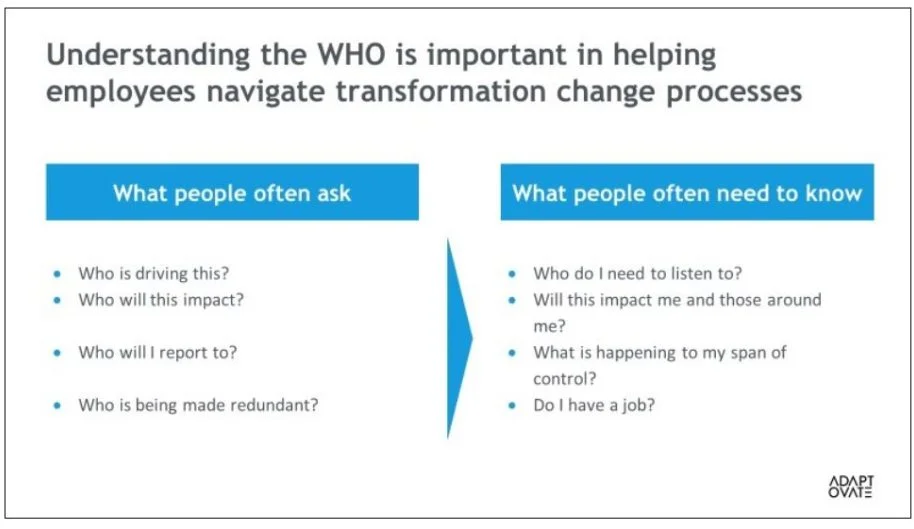
Leaders may not have all the answers when announcing change, but initiating the conversation early and fostering open communication allows individuals to better align their expectations with the change process.
Identifying who will be making decisions and communicating information as early as possible is crucial. Engaging and informing these individuals can be a key driver of successful change. Groups to consider include;
- Senior Management – Communicate high level purpose and provide organization wide updates
- Human Resources team members –Answer specific questions on the strategic workforce plan including role, title and process
- Line Managers – Work with individuals to answer and follow-up on questions related to both the future and transition state
“It is important to remember that line managers play a pivotal role during workforce change. They are the people who most employees will go to, to source information. They are also charged with the performance management of the people who are required to deliver value during the time of change. Ensure you have a plan to engage and inform these people as they can be a key driver to successful change” – Steve Walton, Partner ADAPTOVATE
IDENTIFY WHAT YOU WANT TO CHANGE AND MEASURE IT
To assess the impact of change initiatives, organizations should measure relevant metrics. This enables tracking progress, identifying obstacles, and making necessary adjustments for successful implementation.
Track the progress of the change program and measure the success of change initiatives by using an Objective and Key Result (OKR) framework.
There are two key sets of metrics that track the impact of organizational change
- Progress of the change program – Measures the activities of the change program itself
- Success of change impacts – Measures the progress towards achieving the expected outcomes
Regularly review (i.e., quarterly), to understand how the change initiatives are progressing, address roadblocks and adjust as required. Key result metrics may need to be developed to track the impacts, however in many cases the metrics already exist and can be readily sourced to drive meaningful discussion.
1 - Example change program progress metrics
- Number of organization designs delivered
- Percentage of people trained
- Percentage of role changes completed
2 - Example change outcome metrics
- Invoice to cash (process)
- Net promoter index (customer satisfaction)
- Cost of Sale (financial)
Measure the impact of structural changes on teams, by understanding changes in performance and alignment to strategy. The specific measures chosen will be based on the work done by team, three examples are:
- Velocity (speed of work delivery) – The speed of which teams deliver their work. This metric can demonstrate change within stable teams. This shows when teams reduce delays, increase collaboration, and find more effective processes. It is important to note that velocity should not be used to compare teams using different estimation guidelines.
- Defects as a percentage of work (rework indicator)– This indicator reflects the level of rework required and highlights potential areas for improvement in the change process.
- Business Value delivered (alignment to business need)– This subjective metric assesses the value of delivered work and provides insights into the effectiveness of the change initiatives.
It is important to remember that measurements provide data, and often are useful sources of asking more questions to understand the situation. Not all metrics will trend continuously, especially during the change process. For example, when changes are made to composition or working practices, team velocity may decrease before increasing again. Normal patterns like this must be understood when assessing success impacts.
There are multiple activities which both engage employees and prepare the business for post-change challenges. These include:
- Use of recognition and reward programs to incentivize positive performance and behaviors
- Investment in learning and development initiatives to equip employees with the necessary skills for the organization to deliver the types of outcomes required in the future and to assist individuals in career development
- Engagement in performance management discussions to address individual ambitions and barriers to success
When employee cohorts are measured, areas of high performance and improvement can be identified. When regularly reviewed and analysed, metrics such as those below, will help identify areas of success and areas that may require additional support or development.
Positive Behavior Metrics:
- Number of positive peer recognitions received for demonstrating desired behaviors.
- Percentage increase in employee engagement survey scores related to the desired behaviors.
- Number of instances where the individual mentors or supports colleagues in adopting new behaviors.
- Frequency of proactive participation in team meetings or brainstorming sessions.
Skill Improvement Metrics:
- Percentage increase in the successful completion of training programs or courses related to the desired skills.
- Number of certifications or qualifications obtained in the targeted skill area.
- Improvement in proficiency levels based on skill assessments or evaluations.
- Percentage increase in the application of newly acquired skills in daily work tasks.
Collaboration Metrics:
- Number of cross-functional or interdepartmental projects successfully completed.
- Percentage increase in the number of positive feedback items received from team members or collaborators.
- Number of instances where the individual contributes innovative ideas or suggestions during collaborative sessions.
- Improvement in the timeliness or quality of deliverables when working in a collaborative setting.
Individual Performance Metrics:
- Percentage increase in individual productivity or output, measured by relevant key performance indicators.
- Achievement of individual goals or targets directly linked to the desired change outcomes.
- Improvement in performance review ratings in areas associated with the desired change.
- Number of instances where the individual takes the initiative to improve processes or workflows, resulting in measurable efficiency gains.
Remember, these metrics should be customised to align with your organization's specific goals and objectives. It is essential to define clear targets and timeframes for each metric to track progress effectively.
USING MEASURES TO DRIVE LASTING CHANGE
Metrics provide valuable insights, but it is important to remember that they tell a story that requires further exploration. To drive lasting change, organizations should:
1.Incorporate measures into the way of working framework: Establish cadences for meaningful discussions that leverage metrics to drive decisions and actions. Align organizational strategy with Objectives and Key Results, measure progress Objectives rather than focus on only work completed, ensure alignment between teams and resolve dependencies. Encourage regular reflection on performance to foster a culture of continuous improvement.
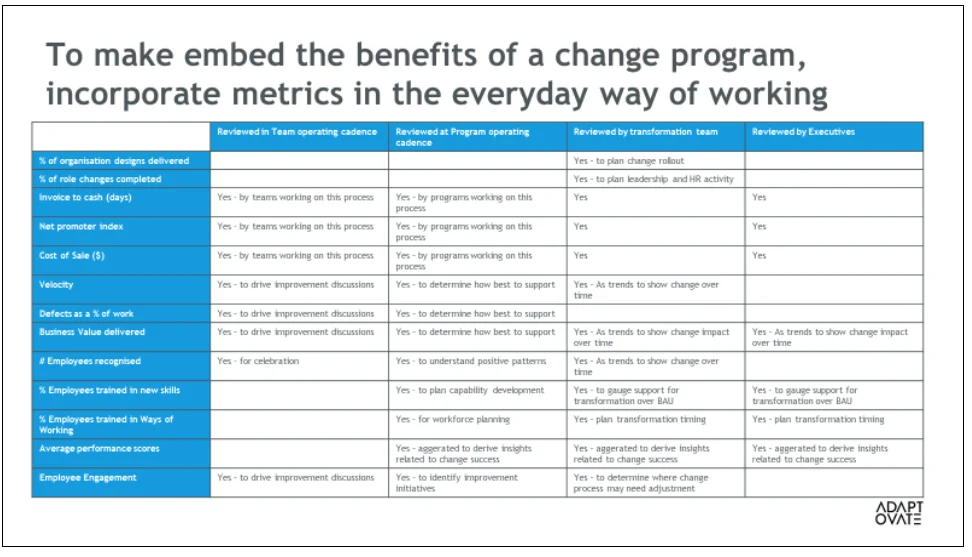
2.Incentivize desired behaviors: Culture plays a pivotal role in sustaining change, so recognise and reward individuals and teams that exhibit behaviors aligned with the desired culture.
a) Incentivize behaviors aligned with the desired change by implementing recognition and reward programs. Visibly acknowledge individuals and teams that actively contribute to the transformation process as well as excelling in professional endeavours and behaviors. Consider performance-based incentives, professional development opportunities, and career advancement prospects.
b)Create an environment that supports and encourages change. This includes providing learning and development opportunities, promoting collaboration, and empowering employees to innovate. Ensure that the organization's culture and policies align with the desired change objectives.
3.Shape the future workforce: Adopt a holistic Employee Value Proposition (EVP) approach to attract and retain individuals who align to the organization’s vision. Beyond monetary compensation, consider factors such as career development opportunities, work-life balance, and a positive organizational culture.
In Conculsion
The future of work involves a clear understanding of how people contribute to organizational Objectives. By employing the metrics and strategies in this article, organizations can effectively incentivize and embed lasting workforce change. Through purposeful communication, targeted measurement, and a culture of continuous improvement, organizations can navigate change successfully, adapt to evolving business landscapes, and position themselves for long-term success.
Related Stories


Our Locations
We partner with clients from offices across the globe. Find the Adaptovate team nearest you.
Get in touch