

Shifting to a T-shaped workforce
Bridging the capability gap: shifting to a T-shaped workforce
One of our clients recently shared with us: We used to be nimbler. We have people with key capabilities in some parts of the business, but when they become busy, we completely lose our ability to do work in that space.
Market disruption is occurring at an unprecedented rate, creating organizational confusion about future capability needs. This disruption has undeniably impacted the hiring process; over the past 5 years, job openings have increased by 9.5%. [Fn 1] Today, more than 10 million jobs remain open in the United States. [Fn 2]
Despite record job openings, organizations are facing a widening gap between the abilities they currently possess and the capabilities they need to move forward. A 2023 survey conducted by ManpowerGroup found that 77% of employers struggle to find the talent and skills they need, a 17-year high. [Fn 3] To thrive in this challenging modern business environment, organizations must prioritize bridging capability gaps by upskilling their employees.
Specifically, organizations need employees that can simultaneously be specialists and generalists to contribute their expertise, collaborate effectively with cross-functional team members, and provide flexibility and coverage in critical skill areas. Coined by IDEO leader, Tim Brown, fostering “T-shaped” skill sets within your organization can help embed responsiveness and resilience in your work. [Fn 4]
Although it may seem challenging, there are steps organizations can take to foster T-shaped skillsets in their workforce to sustain through uncertainty, and scale in prosperity.
“We have people with key capabilities ... but when they become busy, we completely lose our ability to work in that space.”
Organizations must possess diverse skillsets in their teams to help weather the storms of disruption
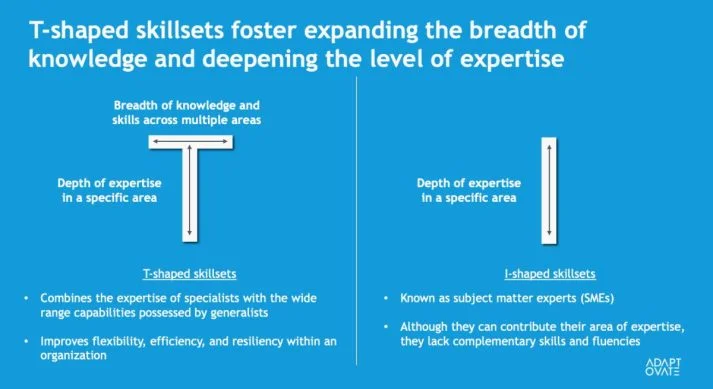
T-shaped skillsets can be described as:
- Where the vertical line of the “T” represents expertise in a specific area
- Where the horizontal line of the “T” represents the breadth of an individual's knowledge and skills across multiple areas [Fn 5]
Many organizations are comprised of employees with I-shaped skillsets. Individuals with “I-shaped” skillsets possess the same subject expertise as those with T-shaped skillsets. However, they lack the breadth of diversified skills.
Brown speaks to some of the difficulties organizations with I-Shaped employees face stating, “Most companies have lots of people with different skills. The problem is, when you bring people together to work on the same problem, if all they have are those individual skills-if they are I-shaped-it’s very hard for them to collaborate.” [Fn 6]
The diversified skills and capabilities of people with T-shaped skillsets make them invaluable contributors to organizations and teams.
There are innumerable advantages of T-Shaped skillsets, including:
- Versatility: Employees possess a wide breadth of knowledge and skills across multiple areas, enabling them to bridge capability gaps and contribute to work outside of their area of expertise
- Communication & collaboration: Team members effectively communicate and collaborate cross-functionally through shared knowledge and understanding
- Diverse perspectives: Individuals with a diverse range of perspectives and competencies can solve problems with a more extensive variety of solutions
- Leadership: Individual contributors begin to exhibit leadership potential because they understand the bigger picture of how different functions within an organization interact
Diversified skillsets impart versatility to the individuals that possess them, and agility in the organizations which embrace them.
“Most companies have lots of people with different skills. The problem is, when you bring people together to work on the same problem, if all they have are those individual skills – if they are I-shaped – it’s very hard for them to collaborate.”
Organizations can derive immense benefits by developing T-shaped Skillsets among their people
One of our clients, the operations leadership team at a preeminent global hospitality brand, faced a dramatic change in customer expectations as the world came out of the pandemic and re-engaged in travel. Concerns of hygiene, cleanliness, and the working order of hotel rooms were top-of-mind for guests.
Company leaders recognized that this presented a unique opportunity to differentiate their brand from competitors and began piloting new techniques and innovations.
The client was able to test out new techniques by leveraging the expert capabilities of their frontline housekeeping and maintenance teams while simultaneously uplifting them through the adoption of new generalist capabilities: agile ways of working, test & learn approaches, and a growth mindset.
Following training, cross-training, and cross-functional team-working, the effort created an immediate boost to the customer and employee experience:
- Customer satisfaction surveys on cleanliness improved - showing a 4% improvement in regional scores and a 5% improvement in individual room attendant scores
- Employee engagement surveys also improved - showing an increased feeling that their work impacted their global brand, increased feeling of team synergy and collaboration, and increased speed of learning
Equipped with new capabilities and mindset, the organization now has the company’s next group of team leaders moving through its talent pipeline.
Building T-shaped skillsets amongst your employees can be implemented on both organization-wide and individual levels
Employees with T-shaped skillsets offer critical contributions in their area of expertise while possessing the versatility to work in different areas and functions.
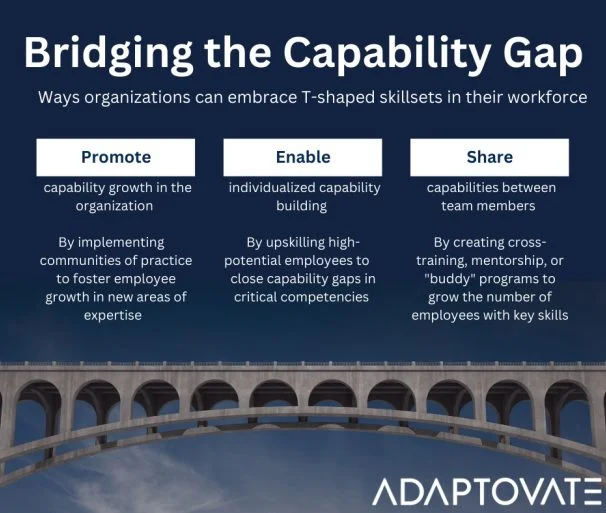
Organizations can bridge capability gaps by encouraging and creating T-shaped skillsets among their employees:
1. Promote capabilities needed in your organization
Implement a center of excellence or community of practice that help foster employee growth in new capabilities. Promote internal capability-building opportunities like 80/20 and stretch projects, case competitions, career paths, and succession planning.
2. Enable individuals to build new capabilities
Build programs that identify high-potential employees for upskilling to help fill needed capabilities, create internal training programs, and partner with third-party education partners to foster attainment in new skills, certifications, or academic degrees.
3. Share capabilities among team members
Create cross-training opportunities, job-shadowing, mentorship, or “buddy” programs between team members.
Organizations, spanning many industries and functional areas, have reaped the benefits of T-shaped skillsets in their workforce and produced immediate and long-term step-changes to their ability to deliver on their mission and business strategy.
Organizations embracing T-shaped skillsets will be more apt to succeed as capability needs shift
Diversifying the skillsets of your workforce also helps build capabilities that may currently be unknown to the world.
Over the past two decades, the rapid disruption of technology and changing market demands have enabled new roles to emerge while forcing others into obsolescence. Consider the emergence of social media influencers over the past decade and their impact on consumer marketing. The early social media influencers and marketers came out of the group that first learned how to consume social media. These early consumers already had the foundational capability on the platforms by the time the market realized the opportunity potential for social media.
While the specific capabilities that will be essential in the future remain uncertain, it is indisputable that organizations that prioritize bridging capability gaps will be more agile and better positioned to succeed as their capability needs evolve.
Notes & References:
Fn 1: US Bureau of Labor Statistics. Annual average job opening levels by industry and region, not seasonally adjusted
Fn 2: US Bureau of Labor Statistics. Economic News Release: Job Openings and Labor Turnover Summary, March 8, 2023
Fn 3: Manpower Group. Q2 Hiring Outlook Optimistic Despite Highest Talent Shortage in 17 Years, Q2 2023
Fn 4 - 6: Chief Executive, interview by Morten Hansen. IDEO CEO Tim Brown: T-Shaped Stars: The Backbone of IDEO’s Collaborative Culture
ADAPTOVATE has helped clients use design sprints in many industries: financial services, fintech, professional services, banking, healthcare, insurance, education, automotive, non-profit, and charities.
Start sprinting, creating, and co-designing customer-centric solutions – contact us today
Authored by:

Nathan Nelson
Alumni of ADAPTOVATE
Related Stories


Our Locations
We partner with clients from offices across the globe. Find the Adaptovate team nearest you.
Get in touch