

Embracing Agile Procurement and Vendor Management for Successful Transformations
In today's rapidly evolving and complex business landscape, organizations are increasingly embarking on large-scale change initiatives and transformations to stay competitive and meet the demands of their stakeholders. However, the path to successful transformation is fraught with challenges and a significant number of these initiatives fail to achieve their intended outcomes. This failure can often be attributed to rigid and outdated procurement and vendor management practices that are ill-suited to the dynamic nature of projects. Recognizing this, there is a growing shift towards agile procurement and vendor management as a strategic response to these challenges.
Agile procurement and vendor management offers a flexible, iterative approach that prioritizes customer needs, team collaboration, and the ability to adapt to change over fixed documentation, processes and tools. This approach not only ensures that procurement decisions are closely aligned with the strategic goals of the organization, but also enhances the speed, flexibility, and creativity within procurement teams. Moreover, it fosters a collaborative partnership with vendors, enabling all parties to adapt to changing circumstances and co-create maximum value throughout the project, relationship and beyond.
As with any change, adopting an Agile approach to procurement and vendor management requires fundamental shifts in leadership and team expectations of how vendors are sourced, contracted, and managed (see Figure 1).
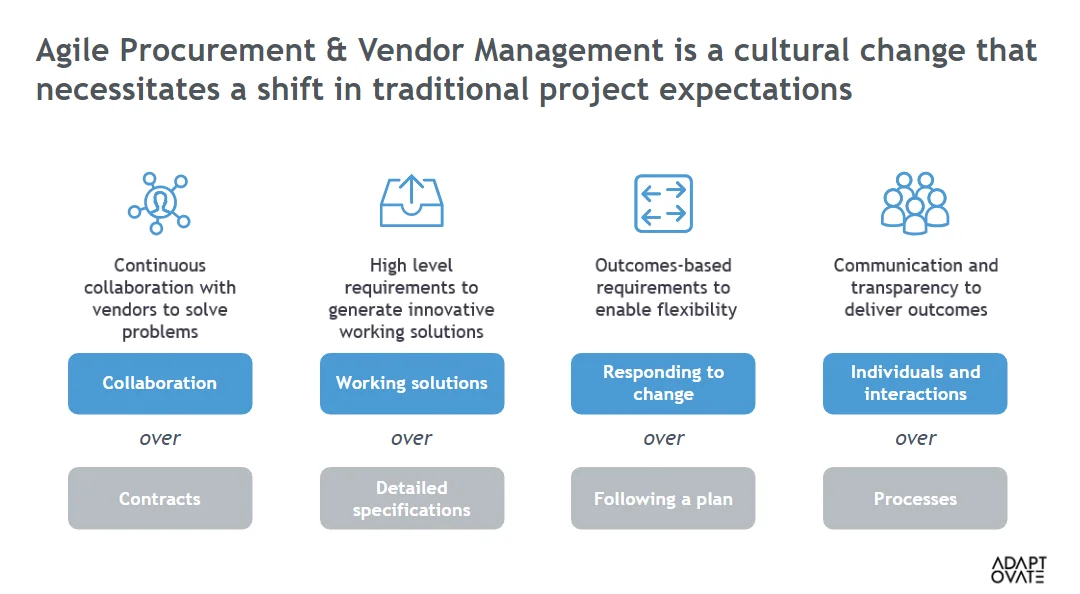
Figure 1
This Agile approach can be broken down into three main components.
1. Agile Procurement Process
Agile procurement involves working closely with vendors to develop solutions that meet specific organizational needs. Agile procurement improves speed, flexibility, and creativity within procurement teams, enabling them to become resilient to changing demands. It is structurally customer-centric, ensuring that procurement decisions are closely aligned with customer needs (see Figure 2).
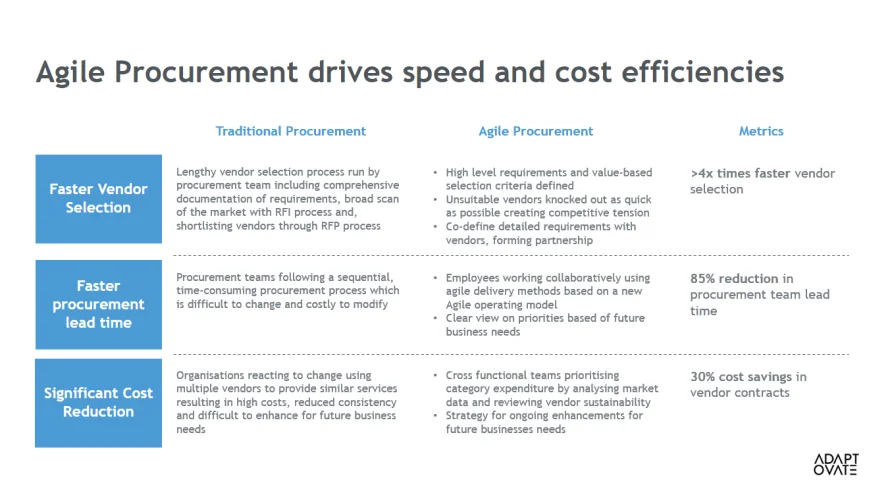
Figure 2.
This process is characterized by three main phases: Definition, Selection, and Contracts. In the Definition phase, the project team prioritizes system and process benefits, describing these as business scenarios to vendors.
During the Selection phase, vendors are ranked with respect to the criteria that match the organization’s scenarios, rather than paper-based responses to detailed requirement specifications that assume perfect knowledge and traditional weighting on delivery within time and budget (see Figure 3).
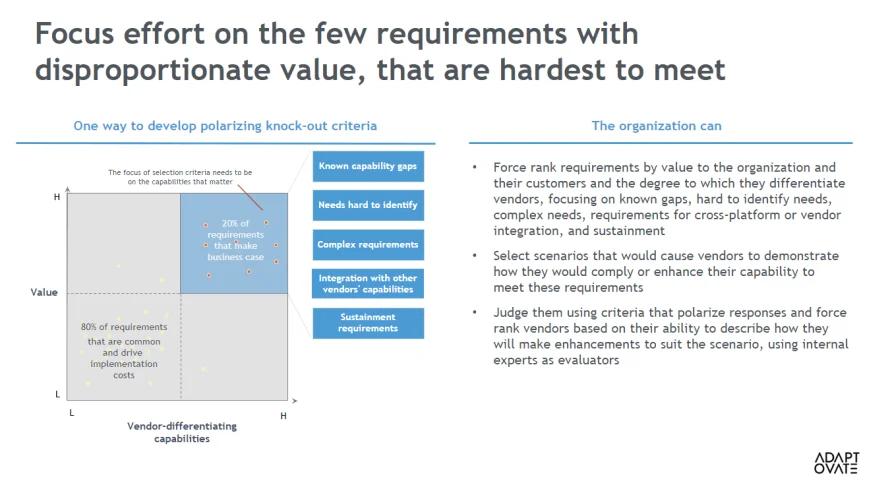
Figure 3.
Finally, the Contracts phase involves implementing agreements that reflect the realities of working in an agile manner, often through a Statement of Objectives (SOO) that aligns both parties on desired outcomes.
2. Agile Vendor Management
Agile vendor management complements the above by focusing on relationships between the organization, vendors and suppliers post-contract award, fostering a partnership that can adapt to changing circumstances and encouraging the co-creation of maximum value.
Post-contract award, the focus is on establishing and maintaining a collaborative relationship with vendors that can evolve as needs change. This includes ensuring vendors understand and align with agile methodologies, managing risks, and ensuring contractual compliance in an agile context. The aim is to create a partnership approach rather than a transactional relationship, fostering continuous improvement and adaptation (see Figure 4).
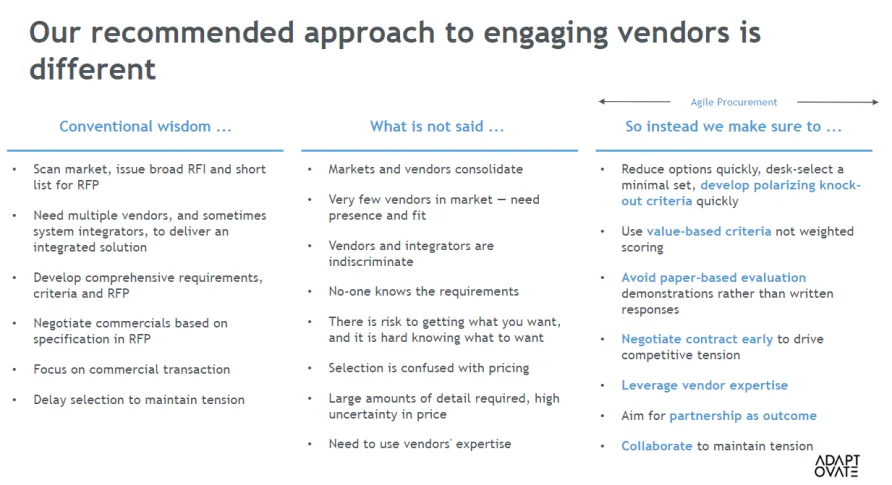
Figure 4.
3. Agile approach to Documentation
A key aspect of an Agile approach to procurement and vendor management is the preference for a Statement of Objectives (SOO) over a Statement of Work (SOW). While a SOW is a detailed document that outlines specific instructions and requirements for a project, a SOO is a high-level document that focuses on project goals and objectives, allowing for greater flexibility and innovation in how the work is accomplished. This distinction supports the agile principles of flexibility, collaboration, efficiency, customer focus, risk management, and simplicity in contracting (see Figure 5).
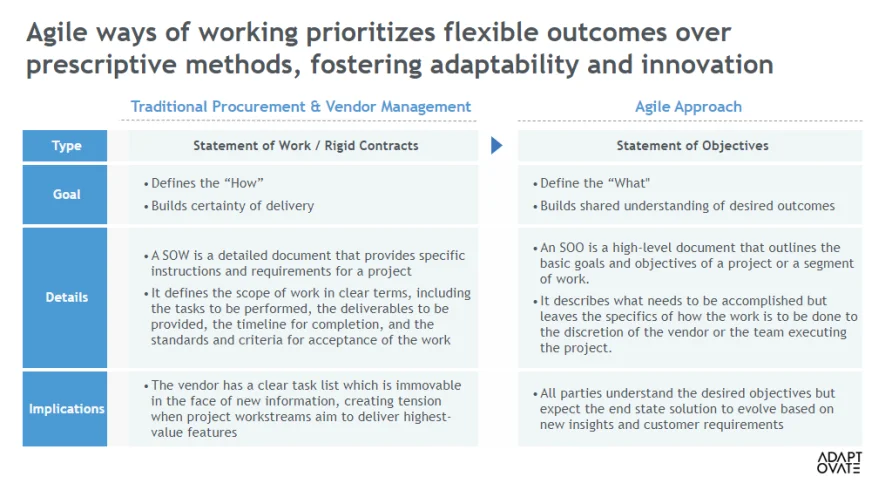
Figure 5.
In particular, a SOO outlines the basic goals and objectives of a project or a segment of work. It describes what needs to be accomplished but leaves the specifics of how the work is to be done to the discretion of the vendor or the team executing the project. This allows for greater flexibility and innovation, as vendors can propose their own methods and approaches to achieve the desired outcomes. The SOO is less prescriptive and more focused on the "what" rather than the "how".
In summary, Agile Procurement and Vendor Management represent a paradigm shift in how organizations approach and manage their vendor relationships and procurement processes. By adopting these agile practices, organizations can become more resilient, responsive, and capable of delivering high-quality, valuable outcomes in a flexible and adaptive manner.
Learn more about how ADAPTOVATE can assist your Procurement and Vendor Management with Agile Ways of Working
Related Stories


Our Locations
We partner with clients from offices across the globe. Find the Adaptovate team nearest you.
Get in touch